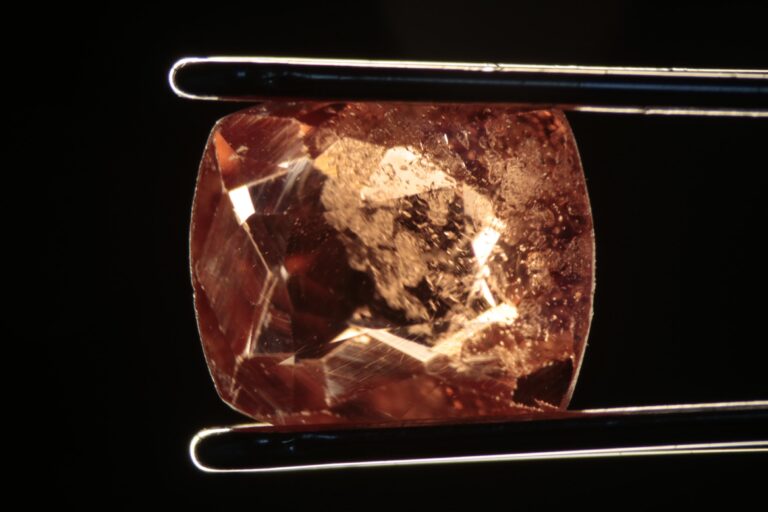
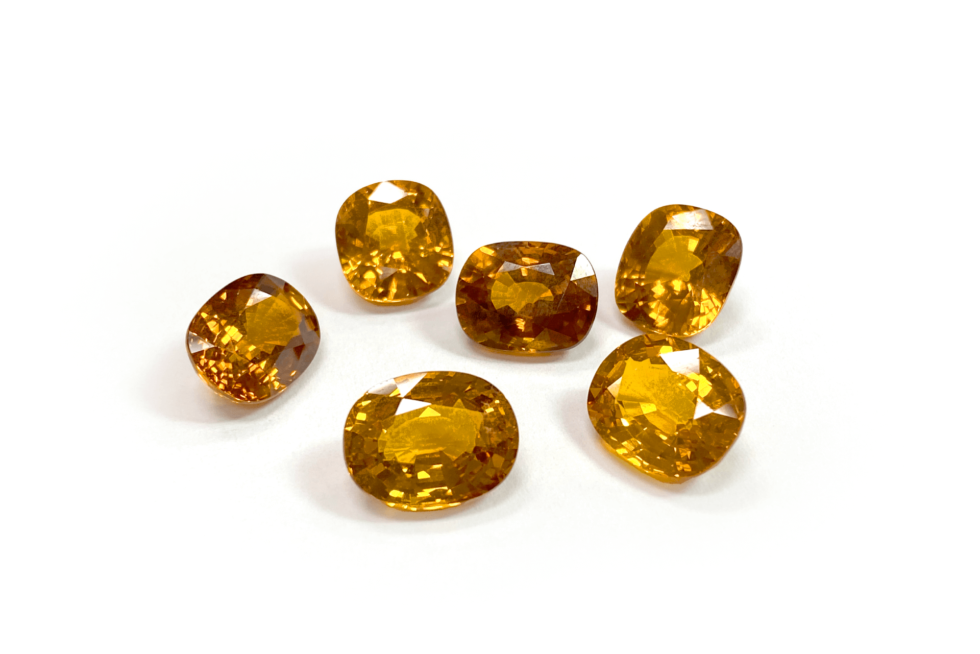
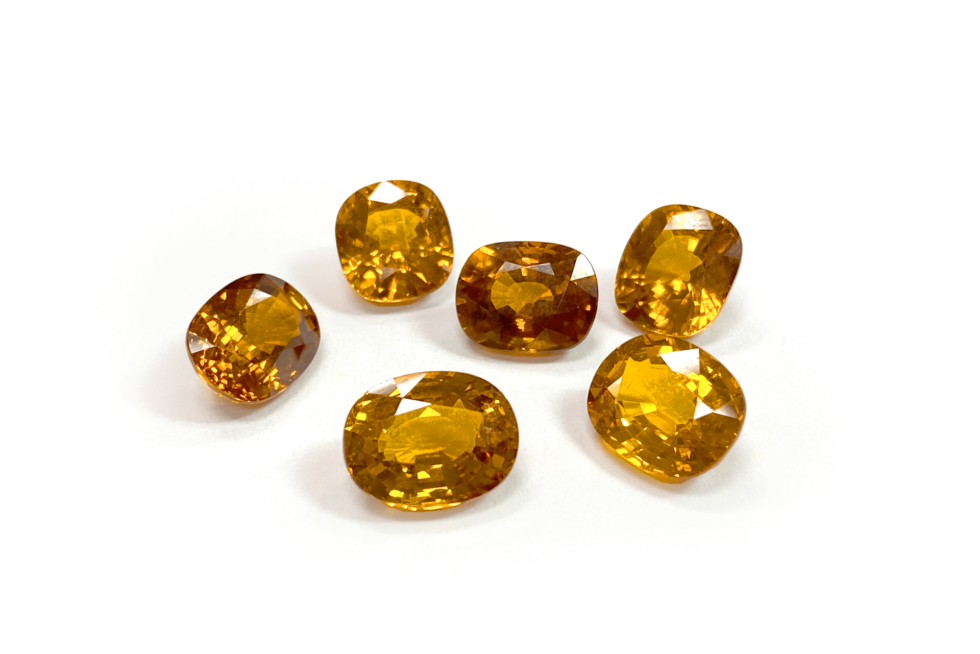
 Figure 1
The six beryllium diffused, high Fe, yellow sapphires described in this report.
Step into the captivating world of gemstones, where hidden secrets and fascinating discoveries await!
A treatment that caught the trade off guard
Gemstone enthusiasts and traders were caught off guard when the AGTA Gemological Testing Center in New York issued a warning in 2002 about the emergence of beryllium-diffused rubies and sapphires on the market. A new chapter in gemstone treatments emerged as beryllium diffusion took center stage. This innovative method carried out at high temperatures using a flux, resulted in significant visual transformations of rubies and sapphires. This treatment leads to significant changes in the color and properties of the stones, making it difficult for gemologists to identify them.
What beryllium diffusion does
A significant number of rubies and sapphires flooding the international gem markets had undergone a new treatment method involving the deliberate diffusion of Beryllium into the gemstone lattice. This revelation sparked extensive experimentation, discussions, and debates within the corundum world.
Six yellow sapphires examined
Even after 21 years, a significant volume of these treated rubies and sapphires remains in the market. Recently, a set of 6 intense and evenly colored yellow sapphires were submitted for identification and origin determination at ICA | GemLab.
Let’s take a closer look at the work process of detecting Beryllium within these intense yellow sapphires.
Inclusions under magnification
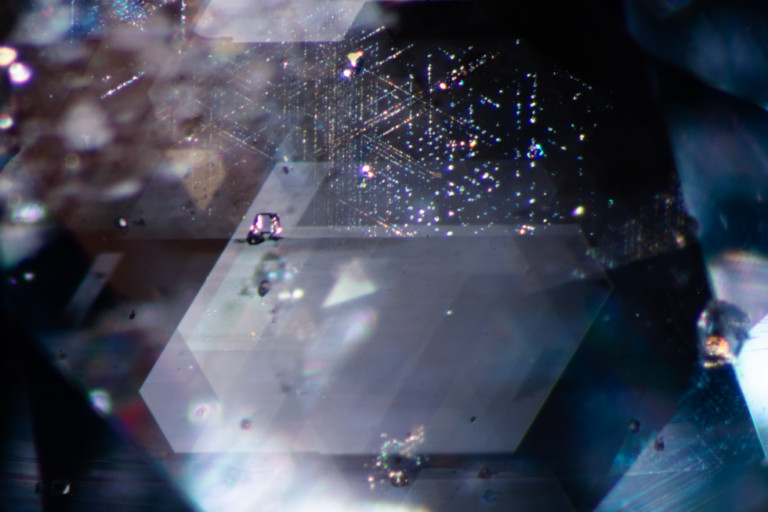
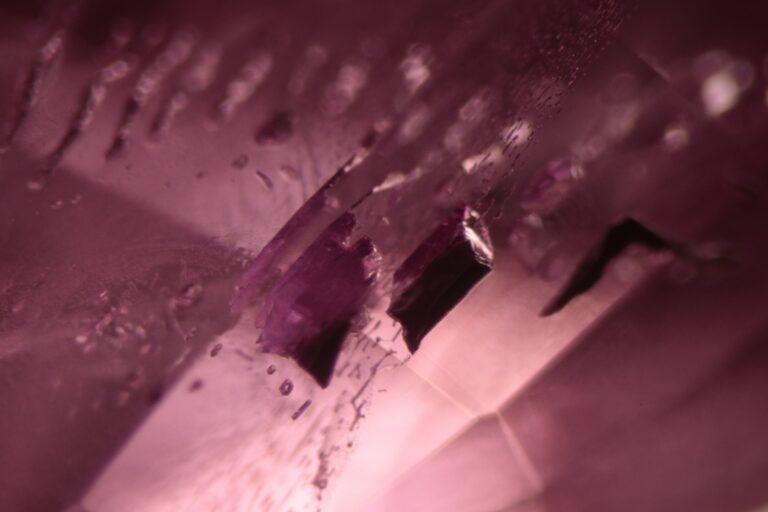
Additionally, the sapphires displayed typical inclusions associated with heat treatment, such as fine particle clouds and heat-altered feathers. Further examination unveiled color zoning patterns instead of the expected even spread of golden yellow.
What the spectra record
Gemologists turned to infrared spectroscopy to delve deeper into the nature of these treated sapphires. The normal practice with sapphire examinations, the infrared spectra were recorded for each of these stones. Interestingly two broad but shallow peaks were recorded at 3065 and 2504 cm-1 in four out of the 6 stones (Figure 9). A read of the literature finds a paper by Balmer and Krzemnicki (Balmer, 2015) where they report on an experiment in beryllium diffusion where two similarly positioned broad peaks were induced (a band at 3053 and a less pronounced band at 2490 cm-1) in specimens. The exact relationship between these peaks and beryllium diffusion remains a subject of ongoing research, intriguing gemologists to explore further.
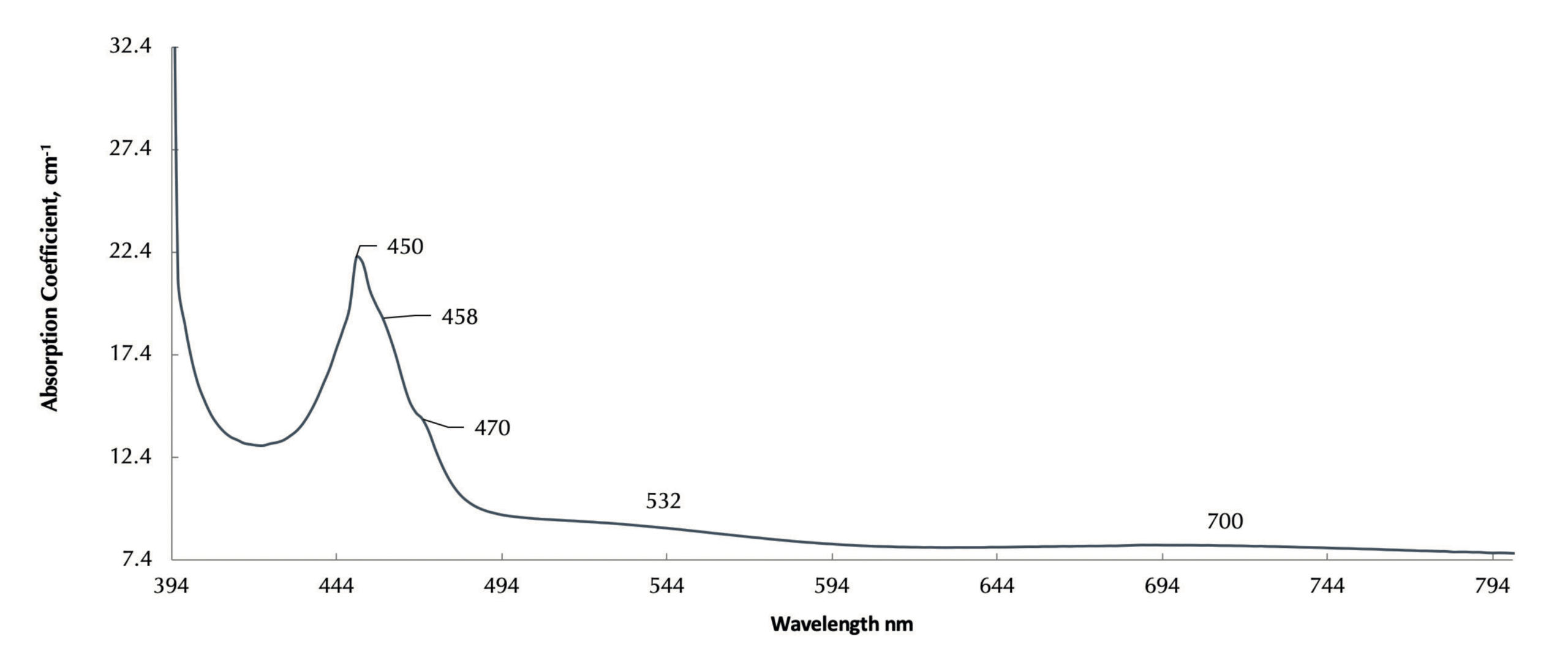 Figure 2
The recorded UV/visible spectrum of a beryllium diffused sapphire revealing a strong absorbency at 450 nm (the 450 complex 450, 458 and 470 attributed to Fe3+–Fe3+ pairs (J. Emmett, Dubinsky, E, V., 2017).
Trace element chemistry
The use of cutting-edge technology allowed gemologists to measure elemental compositions quantitatively. Trace element analyses using LA-ICP-MS were performed on the yellow sapphires to gain deeper insights. Results revealed a notable presence of iron (Fe) and, significantly, an average beryllium (Be) content of 38.1 parts per million (ppm) within the stones, unrelated to tantalum (Ta), niobium (Nb), or tungsten (W). This analysis confirmed the artificial diffusion of Beryllium into the sapphires, confirming suspicions and highlighting the need for continued vigilance in the gemstone trade.
What this means for buyers
The journey into beryllium diffusion in sapphires has shed light on a captivating phenomenon that has intrigued gemologists for over two decades. With ongoing research and technological advancements, gemologists and traders can navigate the market with heightened awareness and understanding of the different types of treatment in their Gemstones.
As such, traders need to be extra vigilant when making purchases to ensure they do not unknowingly acquire treated stones.
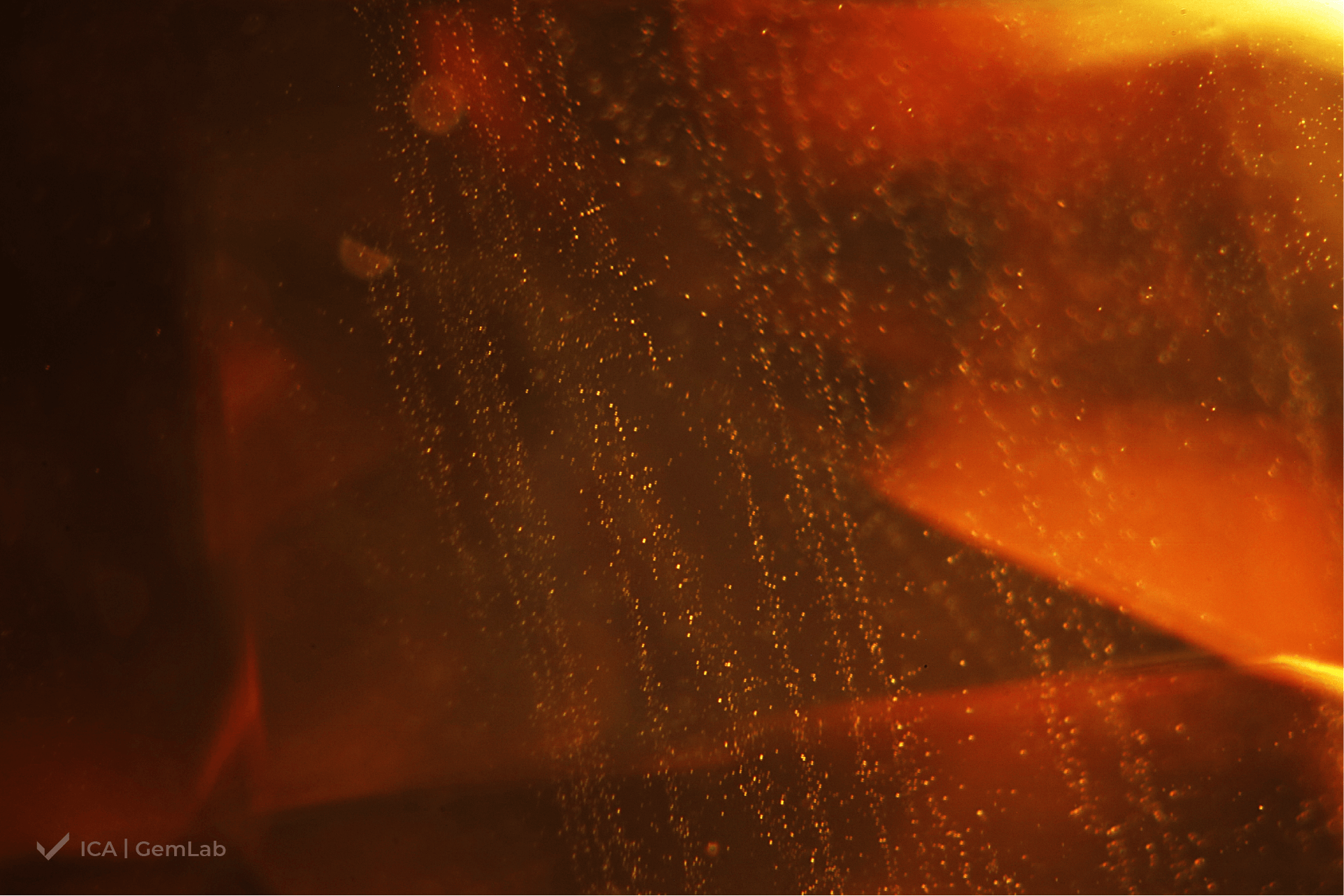 Figure 3
“Strings” of fine dust-like inclusions within a beryllium diffused yellow sapphire recently examined at ICA | GemLab.
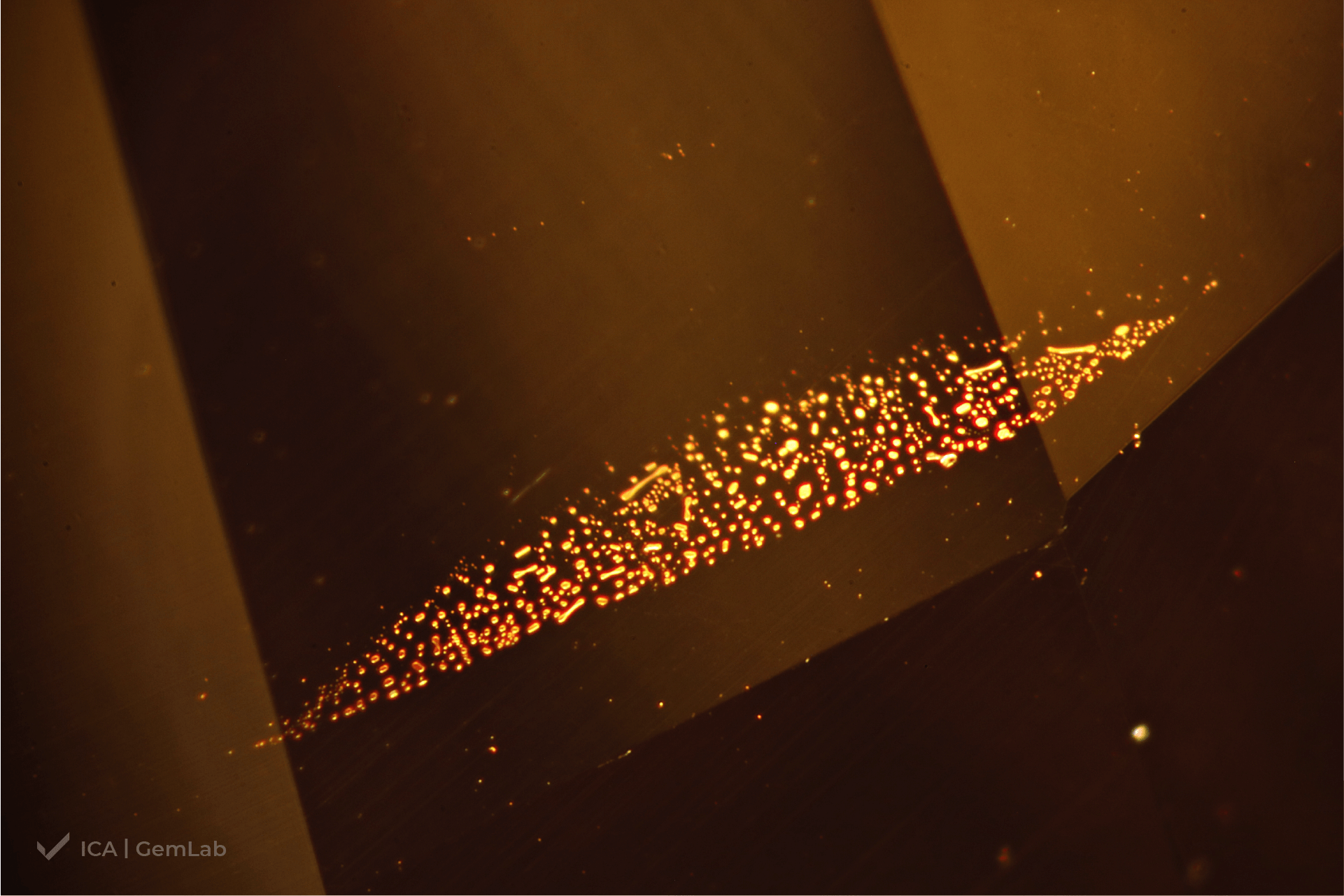 Figure 4
Heat altered feather within a beryllium diffused yellow sapphire recently examined at ICA | GemLab.
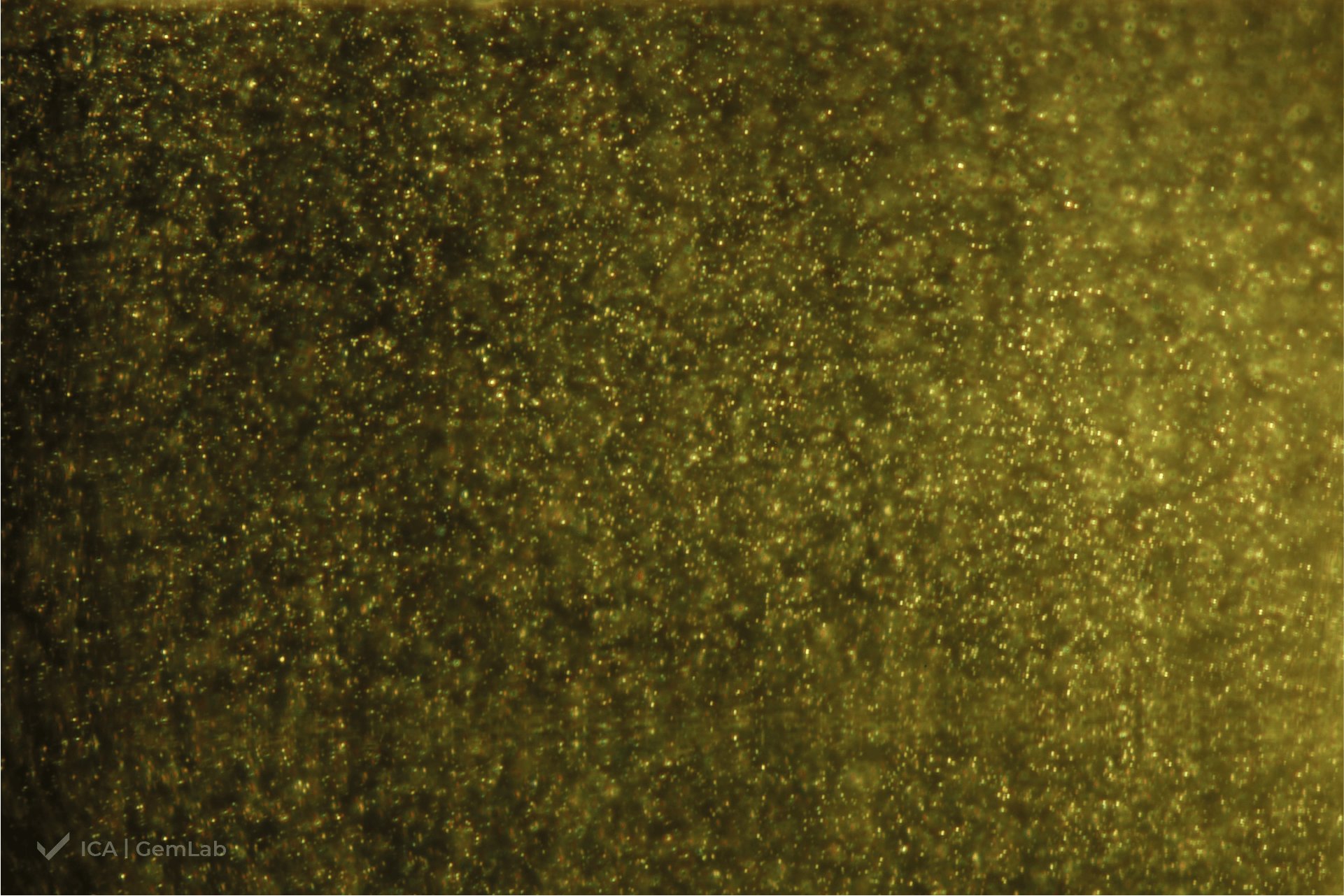 Figure 5
Cloud of fine dust-like inclusions within a beryllium diffused yellow sapphire recently examined at ICA | GemLab.
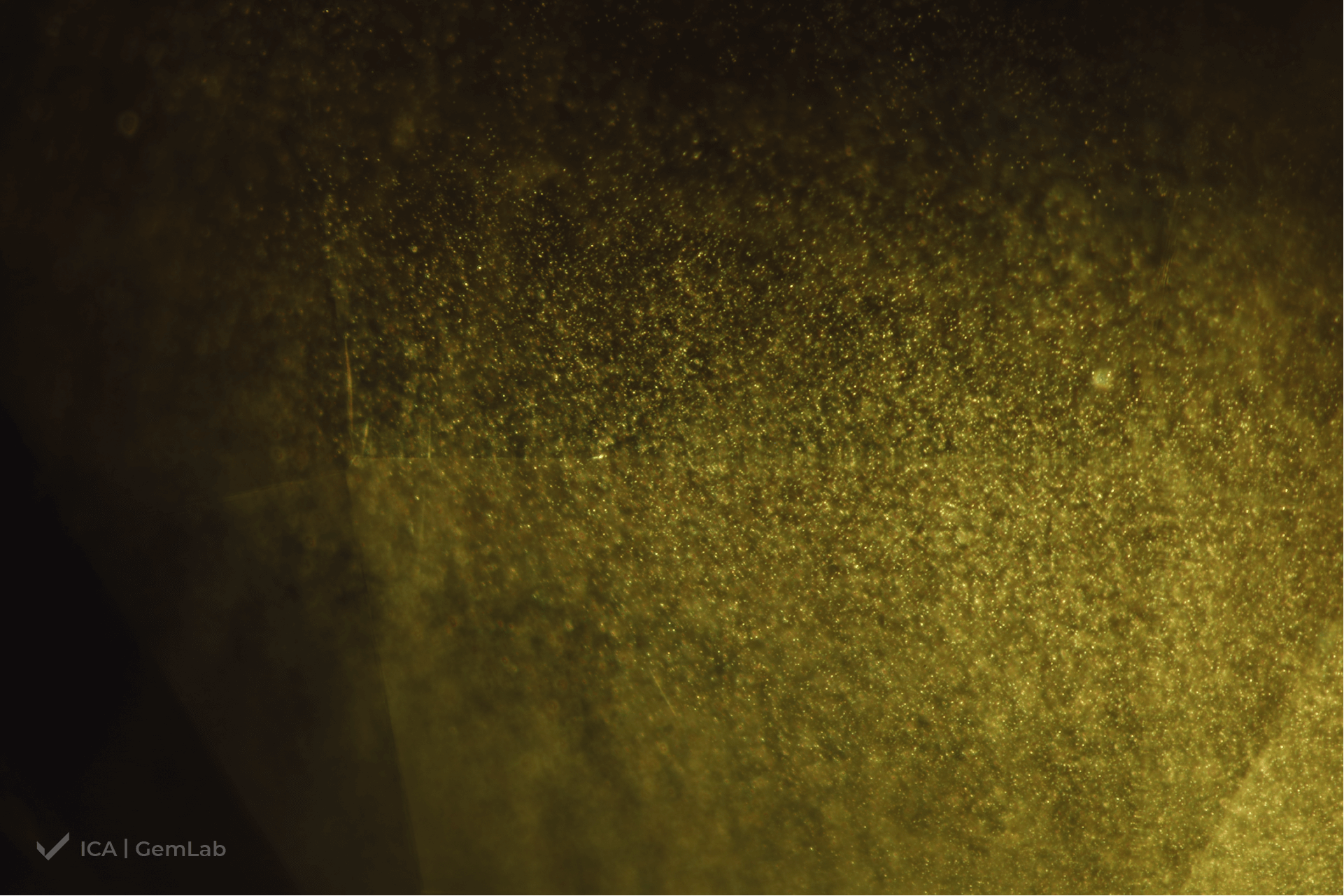 Figure 6
Cloud of fine dust-like inclusions within a beryllium diffused yellow sapphire recently examined at ICA | GemLab.
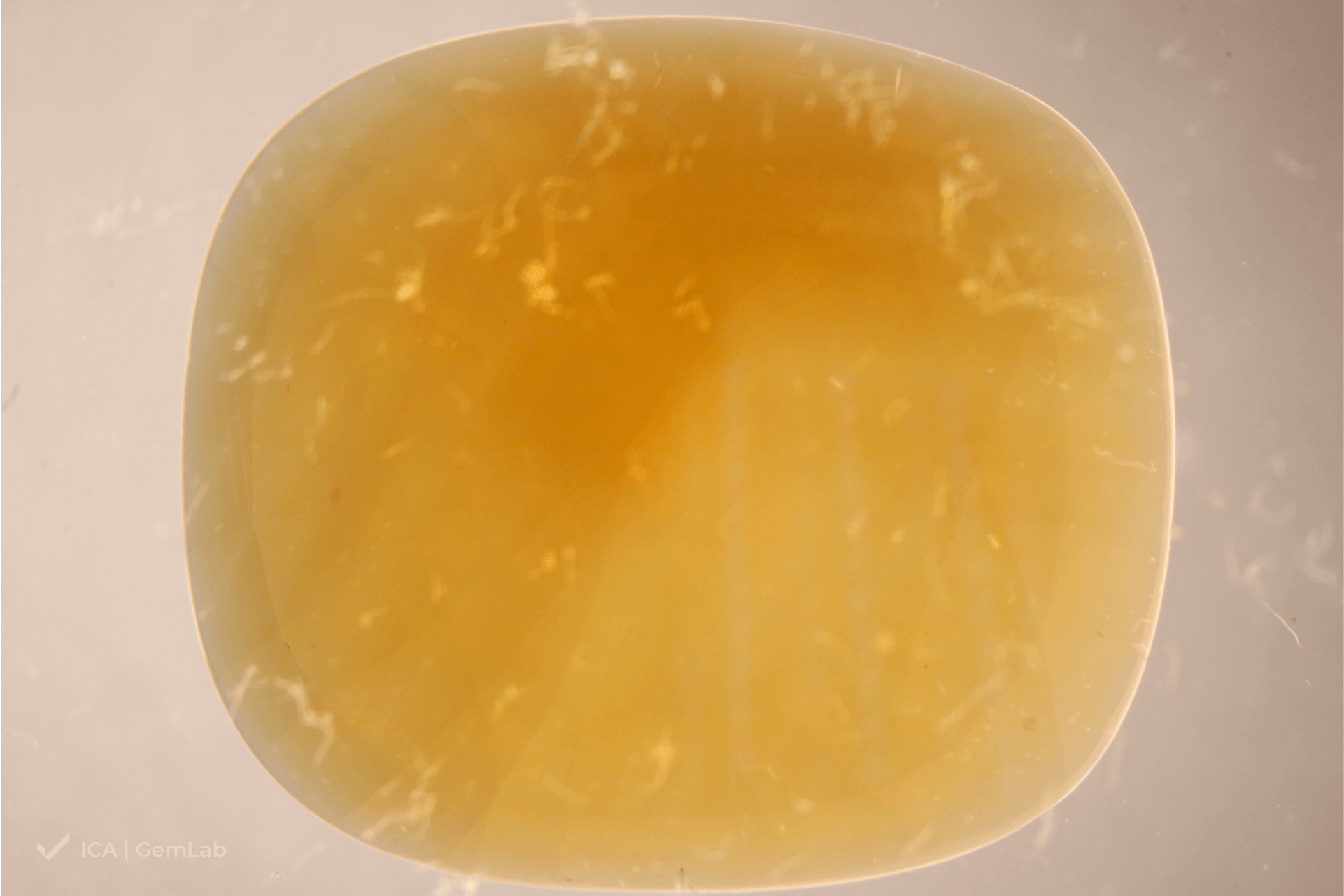 Figure 7
Angular color zoning within a beryllium diffused yellow sapphire, seen while immersed in methylene iodide, recently examined at ICA | GemLab.
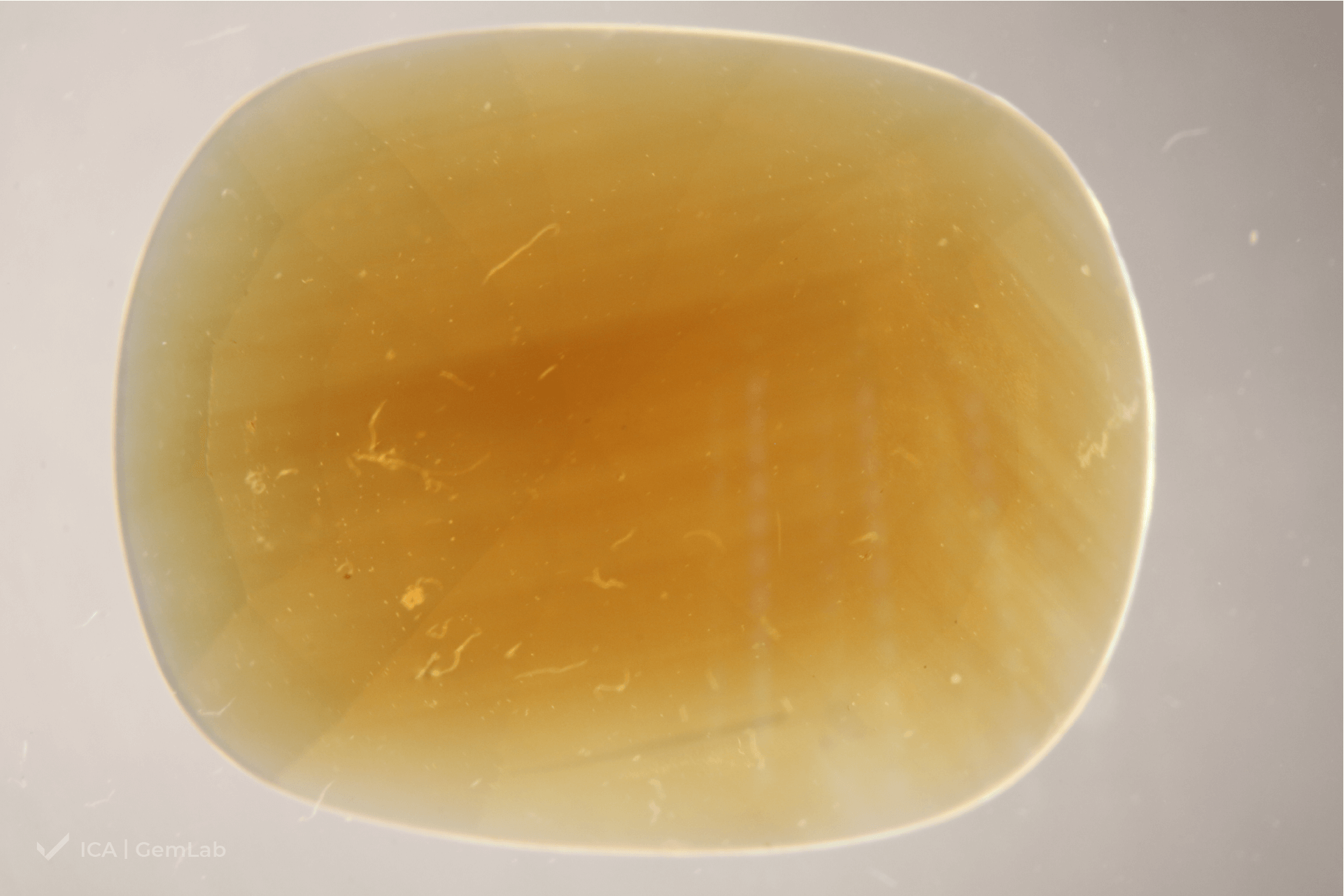 Figure 8
Angular color zoning within a beryllium diffused yellow sapphire, seen while immersed in methylene iodide, recently examined at ICA | GemLab
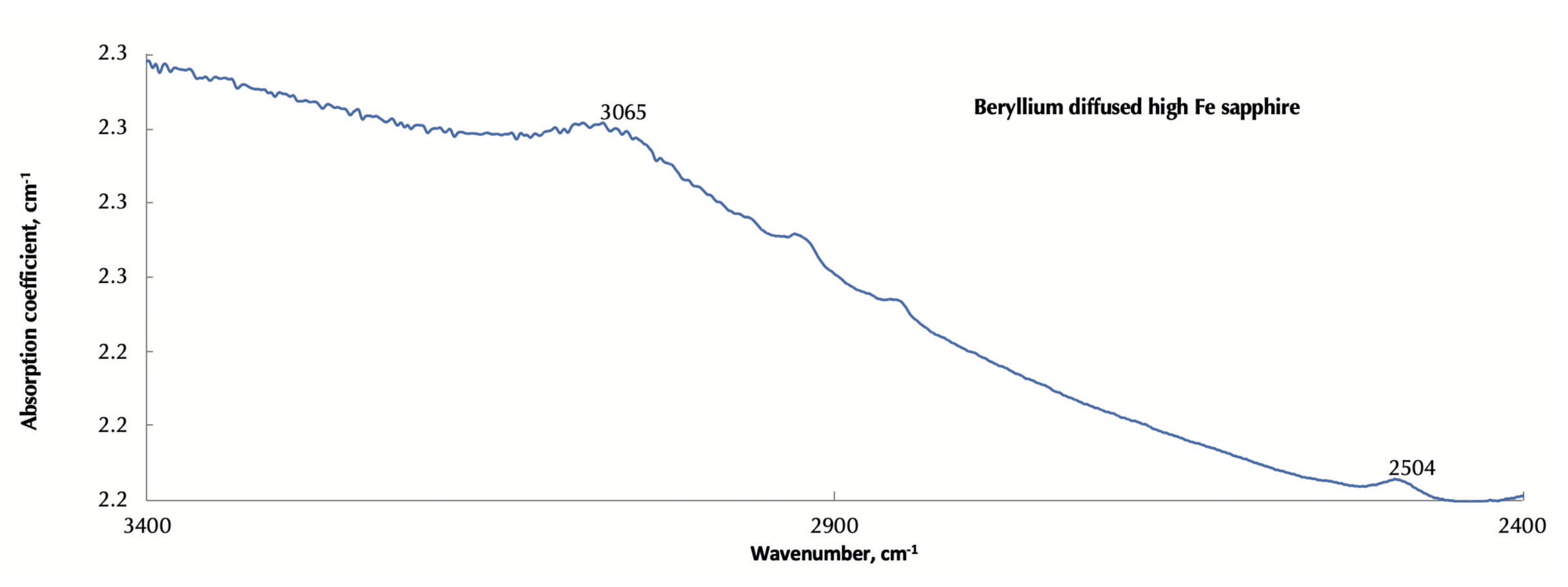 Figure 9
The infrared spectrum recorded for a 6.03ct yellow beryllium diffused sapphire recently examined at ICA | GemLab. Note the board but shallow peaks at 3060 and 2504cm-1.
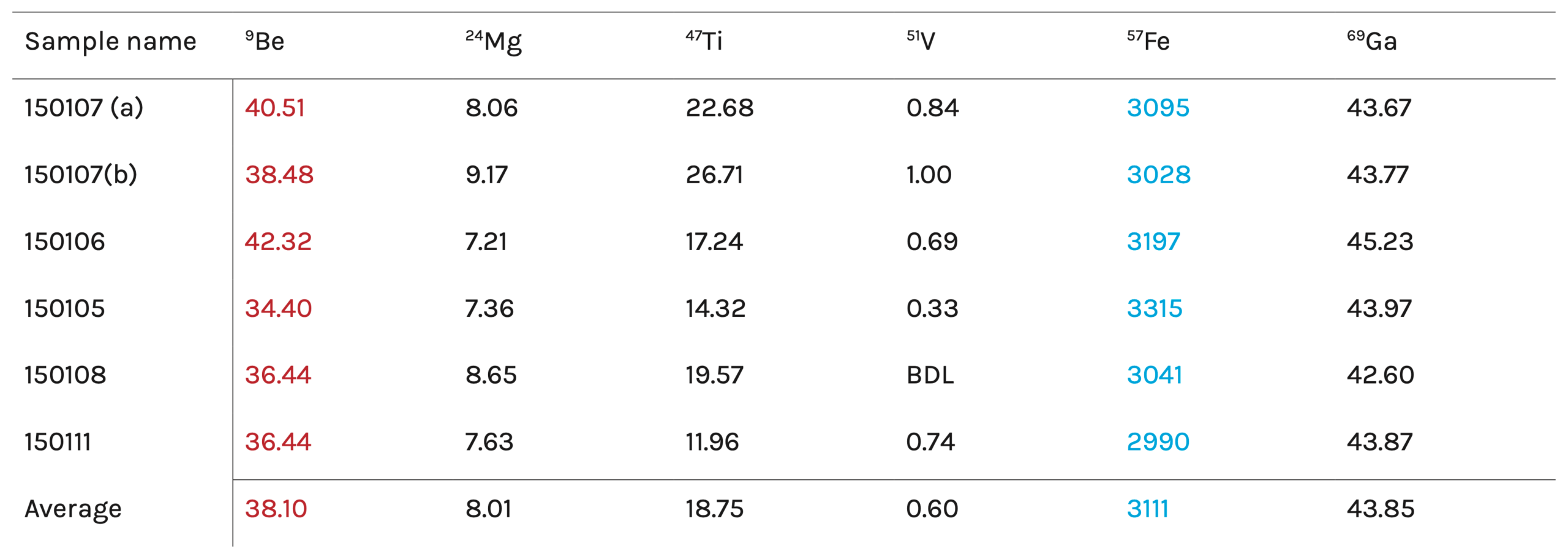 Table 1
The trace element chemistry, in ppma (parts per million atomic), for the six beryllium diffusion treated yellow sapphires. Beryllium was recorded in all of the samples and averaged 38.1 ppma and was de- termined as being of an unnatural origin by virtue of the lack of association with Ta, Nb, or W (Pardieu, 2013). Note that the Fe content averages 3,111 ppma for all samples. BDL = below detection limit.