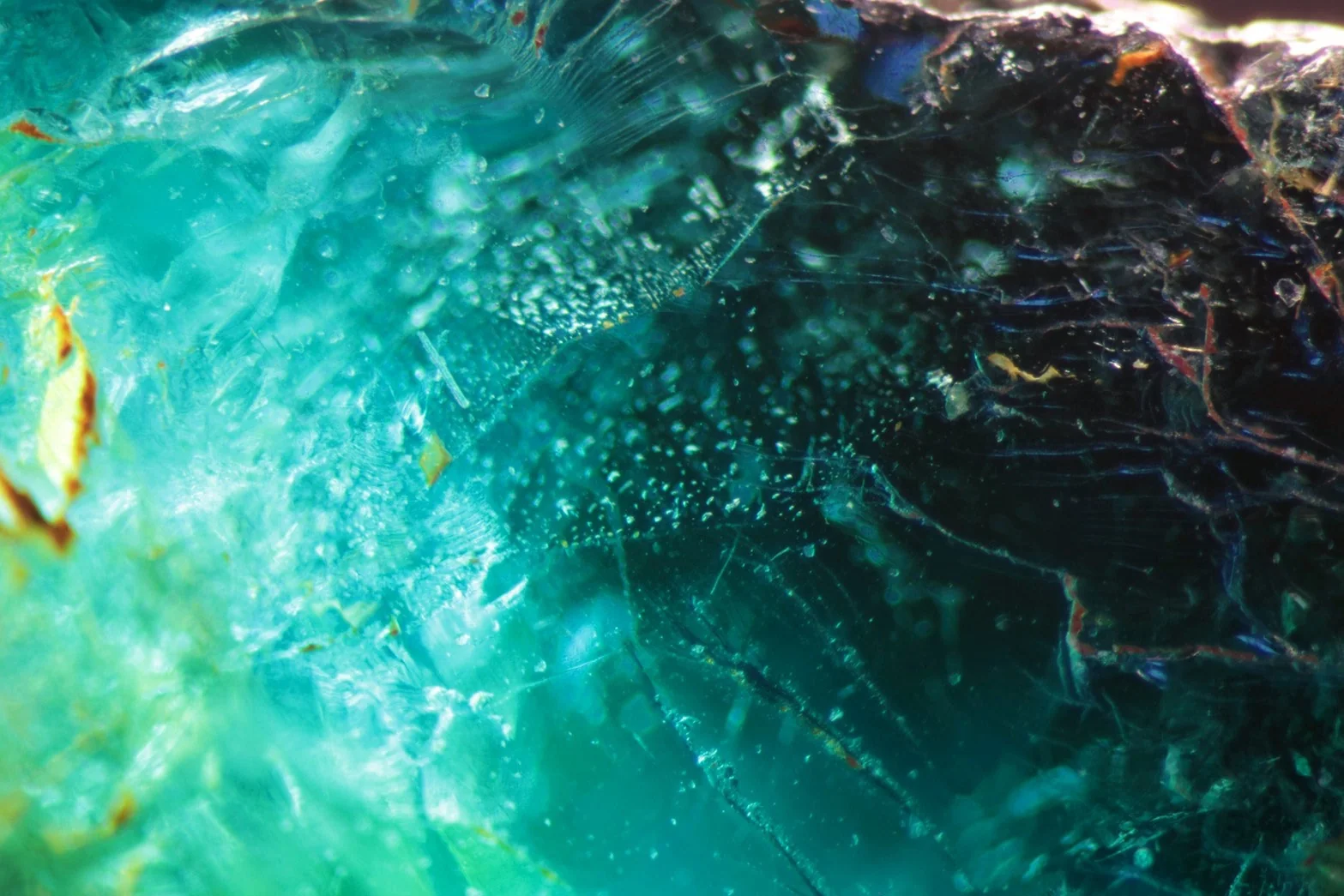
Tourmaline takes its colour from small quantities of other elements caught up in the crystal as it grows. In copper-bearing tourmaline three of them do most of the work, and which one dominates decides both how the stone looks and what a laboratory can call it.
Three elements, three effects
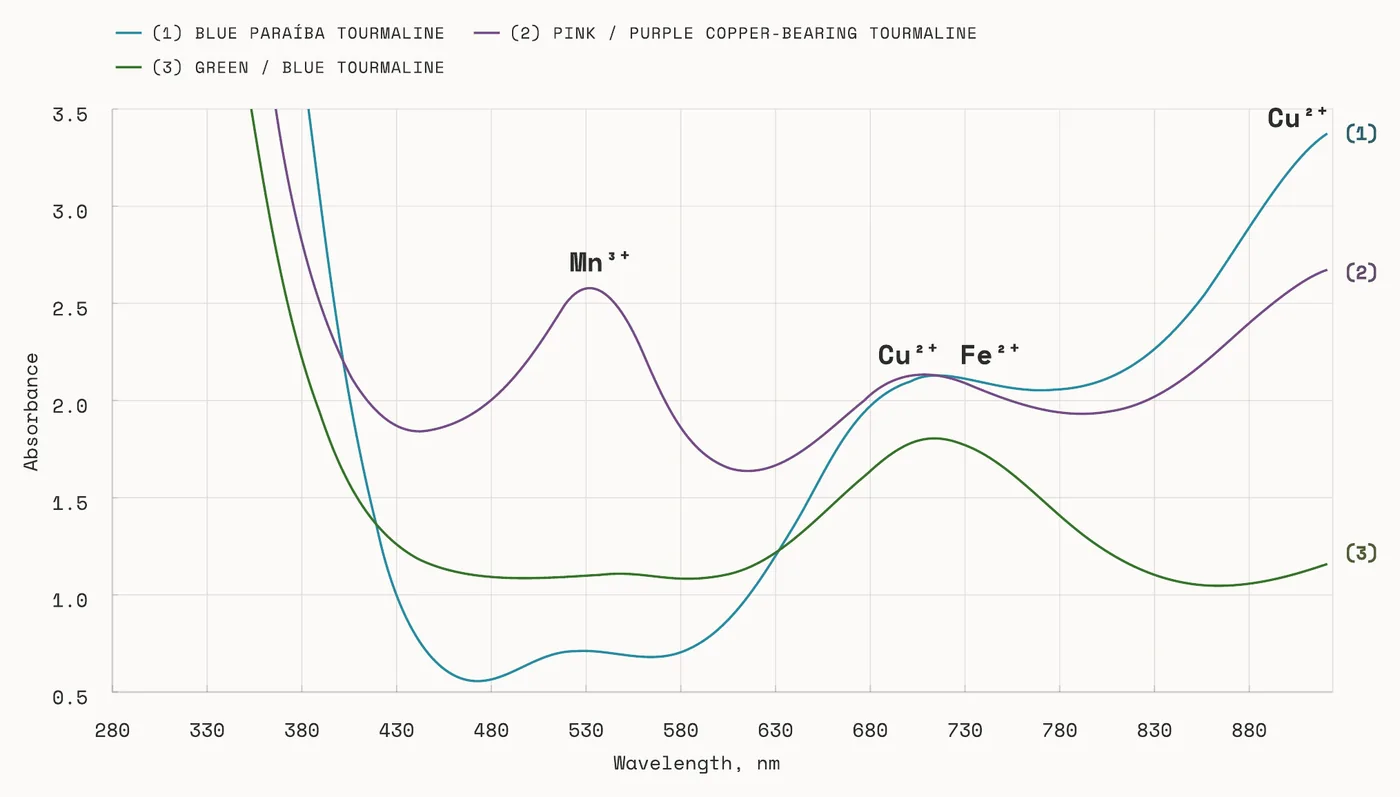
Copper, as Cu2+, produces the blue. In the laboratory’s study of tourmaline from the new Ethiopian deposit at Abuloo, copper absorbs light in the red and near infrared, which is why the stones look blue.
Manganese, as Mn3+, produces pink and purple, absorbing in the green part of the spectrum.
Iron, as Fe2+, pushes the colour towards green and blue-green.
Most stones contain more than one of the three. In the green to blue stone shown in Figure 6, iron dominates; in the pink to purple one, manganese dominates with copper and iron present in the background. The colours seen across the Abuloo material, from black to near-colourless, are combinations of these three chromophores, which is the term for an element that gives a mineral its colour.
Why this decides the name
“Paraíba” describes copper-bearing tourmaline in which copper is responsible for the colour and the appearance falls within the range agreed in the LMHC nomenclature. A stone can contain copper and still not qualify, if iron or manganese is doing most of the colouring or the saturation is too low.
That is why the assessment cannot be made by eye. Looking at a blue-green tourmaline tells you nothing about which element produced that colour. The spectrum does, and chemical analysis measures how much of each element is there. Together they decide whether the stone is reported as Paraíba tourmaline or as copper-bearing tourmaline.
The nomenclature itself is covered in is Ethiopian Paraíba real Paraíba.
The element that does nothing
The Ethiopian material had a surprise in it. Some of the samples studied carry vanadium at up to about 1,000 parts per million by weight, a high figure for a trace element. Vanadium colours other gemstones strongly: it is behind much of the green in tsavorite garnet and plays a part in emerald.
In these tourmalines it does nothing visible. Even the samples richest in vanadium showed no vanadium-related absorption band in their spectra. The element is present in quantity and contributes nothing to the colour.
It does, however, turn out to be one of the most useful elements, with gallium and lead, for telling where these stones came from, which is a good illustration of a wider point: the elements that colour a stone and the elements that identify its source are not the same set, and a laboratory measures both for different reasons.
Frequently asked questions
What gives Paraíba tourmaline its blue colour?
Copper, in the Cu2+ state. Iron and manganese, where present, shift the colour towards green, pink or purple.
Can you tell by eye whether copper is colouring a tourmaline?
No. Two stones of similar colour can be coloured by different elements. Ultraviolet-visible-near infrared spectroscopy and chemical analysis are what establish it.
Does vanadium affect the colour of Ethiopian tourmaline?
No vanadium-related absorption was found, even at about 1,000 ppmw. Copper, manganese and iron account for the colours observed.
The full study is here: The hidden signature of Paraíba and copper-bearing tourmaline from Ethiopia. For the instruments behind these findings, see the services page.